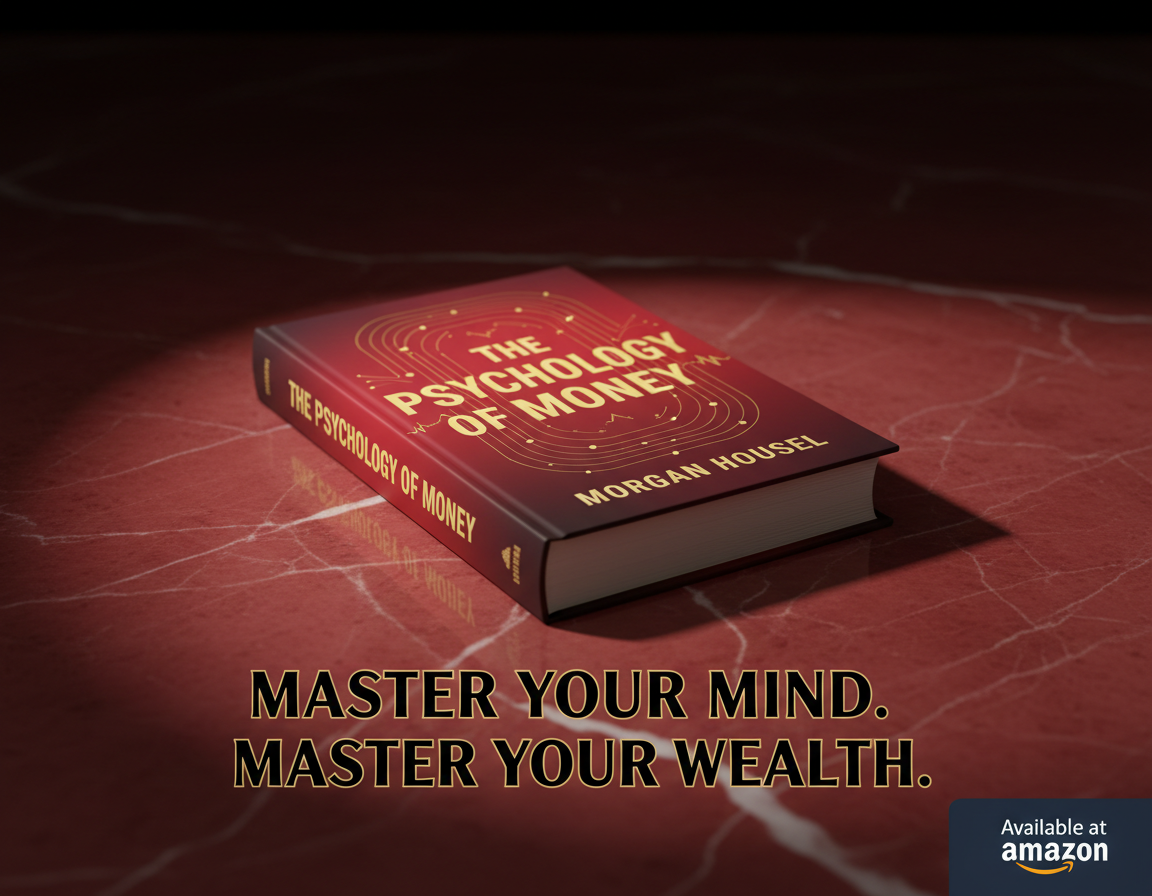
The Behavioral Determinants of Financial Solvency: An Exhaustive Analysis of The Psychology of Money
The traditional epistemological framework of finance has long been dominated by the assumption of Homoiconic, the rational actor who processes data through a purely mathematical lens to maximize utility. However, the emergence of behavioral finance as a critical discipline has challenged this orthodoxy, suggesting instead that financial outcomes are less a function of quantitative intelligence and more a product of psychological disposition. Morgan Housel’s The Psychology of Money: Timeless Lessons on Wealth, Greed, and Happiness represents a seminal contribution to this shift, positing that financial success is a “soft skill” where behavior trumps technical knowledge. This report provides an exhaustive investigation into the nineteen short stories and twenty lessons presented in the work, analyzing the intersections of history, cognitive bias, and economic theory to determine the underlying mechanisms of wealth accumulation and preservation.
Foundations in Authorial Context and Philosophy
Contextualizing the writer’s point of view before breaking down the main ideas of the book is important. Former journalists for The Wall Street Journal and The Motley Fool, Morgan Housel, a partner at the Collaborative Fund, adds a singular blend of financial journalism and venture capital understanding to the topic. Often using narrative to investigate how people negotiate the high-stakes contexts of risk and ambiguity, his background is grounded in the investigation of behavioral finance and the history of investing. Housel’s theory rests on the assumption that finance is more of a soft skill like psychology—governed by unchangeable laws than hard science like physics—where the variance of human emotion introduces a dynamic and unpredictable variable into economic results.
The book is a counterweight to the intelligence trap common in institutional finance, where financial resiliency is usually related to the acquisition of credentials and technical knowledge. Housel’s study indicates that an ordinary person with no official instruction can acquire remarkable money through regular, disciplined conduct while a genius losing control of their emotions could be financial catastrophe. Through a series of historical examples and psychological experiments showing the counterintuitive nature of money management, this fundamental conflict is investigated.
The Mathematics of Time: Confounding Compounding
The core engine of wealth in Housel’s framework is compounding, a process that is often underestimated because the human brain is wired for linear, rather than exponential, growth. The non-intuitive nature of compounding is illustrated by the fact that $99\%$ of Warren Buffett’s wealth was generated after his 65th birthday. While Buffett is undoubtedly a skilled investor, his true “edge” is the duration for which he has stayed invested—more than three-quarters of a century.
Housel uses the geological phenomenon of ice ages to explain the mechanism of compounding. Ice ages are not caused by exceptionally cold winters, but by “slightly cooler summers” that allow a small amount of snow to survive and accumulate year after year. This “progress building on progress” eventually results in ice sheets thousands of meters thick. In finance, this translates to the idea that “pretty good” returns maintained for a long time will always outperform “great” returns that cannot be sustained due to high risk or emotional burnout.
The Psychology of Preservation: Getting vs. Staying Wealthy
One of the most nuanced insights in the book is the distinction between the skill required to get wealthy and the skill required to stay wealthy. Getting money requires optimism, risk-taking, and “putting yourself out there”. In contrast, staying wealthy requires the opposite: humility, frugality, and a “combination of paranoia and frugality”.
This duality is explored through the tragedy of Jesse Livermore. After making $3 billion in a single day during the 1929 crash, Livermore felt “invincible”. This overconfidence led him to double down with leverage on his recent successes, which resulted in total ruin within four years. Housel posits that “getting rich can be the biggest impediment to staying rich” because success breeds complacency and a refusal to adapt to a changing world.
The concept of “Survival” as the cornerstone of investment strategy is introduced here. Survival means being able to withstand short-term volatility and “tail events” so that one can remain in the game long enough for compounding to take effect. A “barreled personality”—optimistic about the long term but “paranoid” about the short term—is presented as the optimal psychological state for wealth preservation.
Complete Recommendations and Conclusions
Through its thorough investigation, The Psychology of Money uncovers a coherent thread: One’s Endurance determines his financial viability. Long-term success depends most on one’s capacity to remain in the game—mentally, emotionally, and financially.
Key Actionable Recommendations for Practitioners:
- First and foremost is behavioral coaching: Less about asset allocation and more about remaining straight-headed during economic downturns, success is
- Include room for mistake in every model: Plans have to weather the unforeseeable.
- Define Sufficiently: Even great returns will cause financial anxiety if there is no set goalpost.
- Embrace Simplicity: Rational, straightforward tactics are simpler to follow and more likely to succeed than more complicated ones.
- Savings are the only factor one has full influence over; hence, concentrate on Savings Rate rather than Returns.
The Final Step: Master the “Soft Skill” of Wealth
As we have seen through the contrasting lives of Ronald Read and Richard Fuscone, the difference between amassing an $\$8$ million fortune and facing total bankruptcy isn’t found in a math textbook—it is found in your daily behavior. Financial success is not a “hard science” where data dictates the outcome; it is a soft skill determined by how you react to greed, fear, and social pressure.
The mathematical formula for building wealth is deceptively simple:
$$\text{Savings} = \text{Income} – \text{Ego}$$
However, as Morgan Housel brilliantly illustrates, practicing that equation in a world designed to generate envy is the hardest challenge you will face. Whether you are a novice investor or a seasoned pro, The Psychology of Money provides the psychological tools needed to “get off the hamster wheel” and find a life of true autonomy and freedom.
Ready to stop chasing “get-rich-quick” formulas and start building a life you control?
Using your money to buy back your time is the highest dividend any investment can pay. Don’t leave your financial future to chance—invest in the behavioral skills that will keep you “unbreakable” in any economy.