
A Critical Study of Enterprise Technology Workforce Development and Engineering Intelligence (2004–2025) in The Pluralsight Ecosystem
The present technical scene is distinguished by continuous change; the half-life of technical skills is shorter than at any period in industrial history. Pluralsight has positioned itself within this context as more than just an educational repository but rather as a crucial infrastructure layer for the world technology workforce. From a modest, classroom-based training firm established in 2004, the organization has evolved into a multi-faceted SaaS platform that combines high-definition video learning, adaptive skill assessments, immersive hands-on labs, and deep engineering analytics. The operational architecture of Pluralsight, its strategic shift toward cloud and artificial intelligence (AI), and the intricate financial reorganization that shaped its path throughout the mid-2020s are thoroughly discussed in this report.
Historical Development and Strategic Redirect
Pluralsight’s genesis may be traced to the shared vision of its creators—Aaron Skonnard, Keith Brown, Fritz Onion, and Bill Williams—who started the firm in Farmington, Utah, in 2004. Pluralsight ran as a traditional boutique training business in its first stage, sending expert teachers to company locations for intense, face-to–face seminars. Though good for profound knowledge transfer, this approach was by nature limited by its absence of scalability and the significant logistical expenses related to physical training. Understanding that classroom training could not match the demand for technological skills, the leadership implemented a fundamental strategic turn in 2007.
Pluralsight democratized access to high-tier technical knowledge by switching its whole curriculum to an online, on- demand video format. This change was exactly timed with the general trend toward cloud computing and agile software development, which demanded continuous, progressive learning instead of sporadic, intense training. The platform’s expansion was propelled even more by its emphasis on expert-led content, created by industry practitioners rather than generalist teachers—a distinction that became a key competitive edge in the fields of software development and IT operations.
Pluralsight evolved from a content source into a technological learning platform over the following decade. By acquiring some major rivals and related technology companies, this change enabled the firm to create a holistic ecosystem able to support an individual from their first lines of code to sophisticated architectural mastery. Reflecting its incorporation into the more general North Texas technological sector, the headquarters changed location from Farmington to Draper, Utah, and finally—following the 2024 ownership changes—to Westlake, Texas.
The Pluralsight Skills Content Ecosystem
At the core of the Pluralsight value proposition is the “Skills” library, a curated repository of over 7,000 technology courses. Unlike many massive open online course (MOOC) platforms that rely on a marketplace model, Pluralsight utilizes a vetted network of over 2,500 industry-leading authors. This model ensures that every course meets specific pedagogical and technical standards before being published. Authors are compensated through a royalty system based on content consumption, a mechanism that incentivizes the creation of high-quality, relevant material. This economic model has created a sustainable ecosystem for professional tech educators, with prominent authors like Scott Allen famously becoming the first to earn over $1 million in platform royalties.

The curriculum is meticulously organized into paths and channels designed to guide learners through complex subjects in a logical progression. These paths cover five primary domains that represent the backbone of the modern digital economy: software development, IT operations, data science, information security, and cloud computing.
Program Development and Infrastructure
The most comprehensive group the platform addresses, catering to full-stack developers, mobile engineers, and systems architects, stays the software development field. It offers basic and sophisticated coverage of languages like Python, JavaScript, C, Java, and Node.js. By concentrating on the settings in which software runs—including networking, server management, and database management—the infrastructure and IT operations categories complement this. The focus in recent years has greatly turned toward DevOps methods that combine software development with IT operations to mirror the contemporary continuous delivery paradigm.
The Artificial Intelligence and Machine Learning Shift

Recognizing the paradigm shift brought about by generative AI, Pluralsight launched its AI+ specialized plan in late 2024. This initiative focuses on the practical application of large language models (LLMs), prompt engineering, and the integration of AI tools into the development workflow. This is not merely a collection of courses, but a comprehensive track designed to help organizations achieve “AI fluency”. This involves training non-technical leaders to understand the strategic implications of AI while simultaneously equipping engineers with the technical skills required to build and maintain AI-driven applications.
Immersive Learning Design: Laboratories and Sandboxes
The restrictions of passive video instruction have caused Pluralsight to invest heavily in immersive, hands-on learning settings. These characteristics aim to close the gap between understanding and action, a change essential in technical disciplines where errors in a production environment can be disastrous.
Task-Based Practice and Guided Labs
Offering a methodical, task-oriented learning experience, Pluralsight has more than 3,500 hands-on labs. In a lab, a student gets objectives and a safe, pre-configured environment. These goals could vary from patching a security flaw on a Linux server to setting up a VPC on AWS. Real-time feedback and validation from the platform guarantee the learner is following the steps precisely before progressing to more challenging tasks.
Cloud and Artificial Intelligence Sandboxes
Pluralsight’s hands-on approach reaches its pinnacle in the Sandbox settings. Open-ended, non-directed settings called sandboxes allow students to experiment without constraint.26 For cloud computing, this entails access to actual AWS, Azure, and Google Cloud consoles. Learners can use these environments without risk of charging their personal or commercial accounts, therefore making this a major differentiating element. Becoming more powerful after A Cloud Guru was included, these sandboxes offer instant terminals and cloud servers enabling complicated architectural research.

Pluralsight also started AI sandboxes when the AI+ program was introduced. Developers can use these areas to safely test prompt engineering techniques and AI integrations, so practicing with generative AI tools and LLMs is made possible.
Analysis of Comparative Market and Posturing
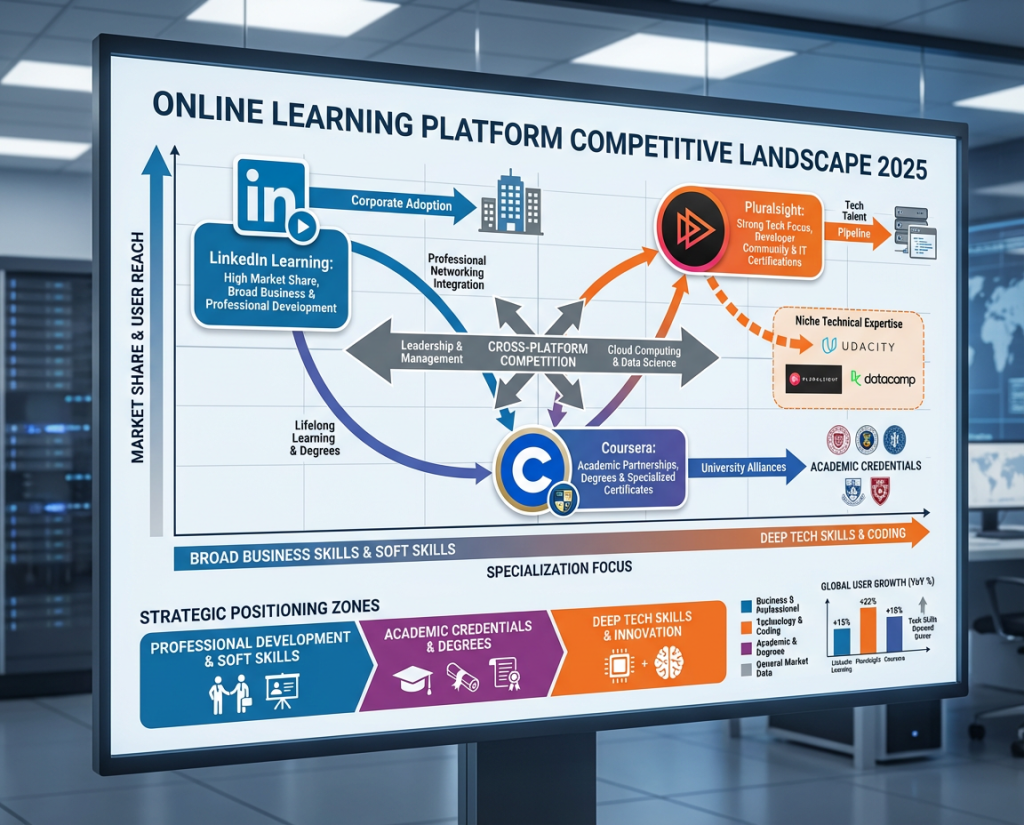
Pluralsight’s emphasis on technical depth and quantifiable results helps it stand out in the very competitive digital learning market. Leader Pluralsight was nominated in the 2025 Forrester Wave for tech skills development tools, which speaks of its powerful plan and market presence.
Pluralsight Versus LinkedIn Learning
Reviewers frequently compare Pluralsight to LinkedIn Learning. Although LinkedIn Learning excels at offering a wide range of professional, commercial, and soft skills, it is sometimes regarded as less efficient for intensive technical upskilling. Developers and IT experts wanting in-depth courses, practical labs, and demanding certification preparation often prefer Pluralsight.43 Moreover, Pluralsight’s Skill IQ and Role IQ offer a degree of numerical assessment unmatched by the qualitative evaluations LinkedIn gives.
MOOCs versus Coursera and Pluralsight
Learners looking for academic credentials or degree-aligned content from universities frequently favor Coursera. Pluralsight, on the other hand, is seen as more practitioners oriented with content that is frequently revised to match industry releases. For active professionals needing to master a particular technology to address a problem in their current flow of work, Pluralsight is the preferred platform; for career changers looking for a theoretical basis, Coursera is excellent.
Cloud Academy versus Pluralsight
The main rival in the cloud industry is Cloud Academy. Though Cloud Academy is well-known for its hands-on settings and organized learning pathways, Pluralsight’s takeover of A Cloud Guru has greatly reduced the difference. Pluralsight now provides a more comprehensive curriculum that covers subjects like frontend development and engineering analysis (Flow), which Cloud Academy does not include.
Ready to Future-Proof Your Career?
There has never been a better time to begin either to create a basis in software development or to spearhead the advancement of artificial intelligence.

Participating now lets you benefit from the AI+ specialized plan, developed to assist you in navigating the age of generative intelligence. You will be actively learning, not just viewing movies, about:
- Under specialist-led paths, master big language models (LLMs), prompt engineering, and generative artificial intelligence principles with advanced AI course.
- In isolated, no-risk settings where you can develop and test without concern about unforeseen expenses, Experiment openly with artificial intelligence tools and services.
- Get quick answers to technical questions and customized recommendations to fill your own skill gaps using Iris, your onboard artificial intelligence learning assistant.
- High-demand credentials like the AWS Certified AI Practitioner should be prepared with endless practice exams and labs reflecting actual situations.
Special limited-time offer
At a fraction of the price, don’t pass on the opportunity to have unrestricted access to the best technological labor development platform in the world.